Artist Statement
Sheena Barnes
We all absorb and internalise influences and traits from whatever is around us. The earliest memorable influence to my practice was the discovery of my father’s sketch book which he kept during the war in the Far East. In WWII my father saw active service in Singapore, Burma and India and he documented his life as a soldier in a visual diary. Completely self-taught, drawing was therapeutic and relaxing for him. His sketchbook inspired me as a child and my personal interactions with the world around me only really became complete when I drew them. When on holiday as a teenager, my father and I would sketch in the countryside and compare notes when our drawings were complete.
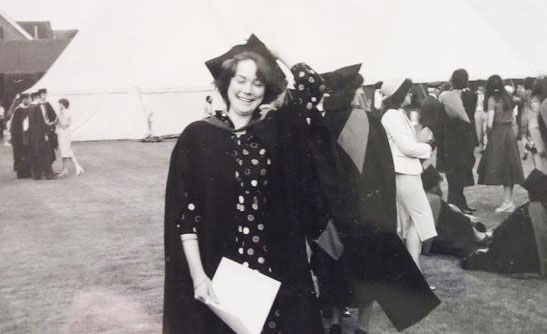
Formal art training began at Central School of Art and Design London, continued at Canterbury College of Art followed by an MA at Reading University under the tutelage of Professor Terry Frost RA. Whilst at Reading I developed an abstract style based on drawings of the hothouse plants and flowers of Kew Gardens, where each sketch or painting contrasted the bright colours and stillness of these exotic plants against the fast-moving train journey getting to Kew.
After completing my art training, I moved to London and shared a house with four other artists. I used a room that was too damp to inhabit as a studio space, where I painted most of the day. At night, I worked, first at the Piccadilly Theatre, then at the London Coliseum. Working there I developed a love of live performance theatre, opera and ballet.
I was Artist of the Month at St James’s Church Piccadilly where I exhibited a 10’ x 8’ canvas called ‘Creation’ which depicted the creation of women and men, spun out of a backdrop of autumnal plants drawn in Kew Gardens. The figures were posed by dancer friends who were working with me at the Piccadilly Theatre and who got me into their ballet school The Place each day to draw. This experience enabled me to draw the moving figure, and trained me well enough that I was later asked to teach MA dance students drawing as part of their anatomy studies.
Every artist will have famous names from the art historical canon whom they credit, and so do I. Matisse has been, and remains, a major influence as far back as I can remember. Pretty much all stages of his work have inspired me. When visiting Tate Britain I did many studies using charcoal of Matisse’s deceptively simple series of four larger than life bronze relief sculptures of a woman’s back [Henri Matisse, ‘Back 1,2,3,4’].
Also influential was his use of line to describe a life model or a face, and the way he captures the energy of a person with one sweep of the pen. I’ve always loved drawing in this way, trying to recreate a figure with only one descriptive line, heavier at some points to imply tone or depth then faint in other places where the light might be striking. I was taught life drawing by artist Anne Martin at Central School of Art. I learnt the importance of economy of line, not using many different lines to describe a figure which can show a lack of clarity and indecision.
I was also fascinated by Matisse’s cut-outs from the concluding stage of his life. This was when he could no longer hold brushes but was able to continue drawing with charcoal attached to a stick, and then cut out the resulting shapes to make those very bright primal coloured collages. This use of primary colours, use of line, pattern, and the flatness of the picture plane is something I’ve carried with me from his work.
Today I’m interested in creating more depth and space in my paintings. I look back on the early influence of Cezanne… I first saw his work when I went on my art school trip to see the Cezanne show in Paris, in the final two weeks of our degree course. The last weeks just before we put up our own paintings in our final show when our work would be judged and degree’s awarded was a very tense time. It was risky to go away at this time before all our work was complete but it was worth the risk to see this amazing show.
This exhibition contained so many paintings gathered from museums across the world. His paintings of ‘Montagne Sainte Victoire’ were riveting as they were massive and you could get up close enough to clearly see his brushwork technique. He used cross hatching and blocks of overlapping colour built up with different widths of brush strokes. Painted at different times of day, in different lights, and changing seasons. He used cross hatching, to convey tone, depth and structure in the landscape. Parallel paint lines that animated each canvas making the whole surface move and pulse to convey life. When you see a reproduction of one of his paintings in a book you see nothing of that surface texture or that dynamic rhythm and movement. Many paintings were huge, so there’s the impact of the physical scale and the sheer number of canvases when you see such a body of work. It was a remarkable exhibition, and made a profound impression on me as a 20 year old.
Kandinsky and Gabrielle Munter were also very important influences at this time. Especially when they were involved with the Blue Rider group. As with Cezanne, Gabrielle Munter used animated brush strokes which created a pulsating surface of living paint.
Kandinsky wrote an essay concerning the Spiritual in Art in which he broke painting down into just three components, line, rhythm and tone. Each element can be taken separately. One can use just lines, rhythm or tone independently. Then you put them all together. It sounds simple: it enables the artist to stand back from the scene you are sketching or the composition you are creating, then when these elements are put together there’s a new unpredictable creation. The work of choreographer Merce Cunningham and composer John Cage seemed to do this same thing in their areas of dance and music. I went to as many of their performances as possible to watch, listen and draw.
I experimented with realism as the other artists I was sharing with were engaged in doing mural work in London hospitals. This involved drawing out your idea/design, and using an epidiascope to project the drawing onto a wall or canvas. I used this technique to paint ‘Soul’ (1984) which described the death of a friend and his soul rising. Alexej Von Jawlensky’s, jewel-like pieces depicting tiny figures close to the sea dwarfed by tall swaying trees made an impression on me. He drew the same view from his bedroom window over a period of years as his health failed. Those paintings were vibrant studies painted in day and night time, in different weather conditions. Hot Summers and snow-covered winters record the small section of landscape he could see as it changed.
I was also inspired by the paintings of Per Kirkby due to the atmosphere he creates in dark landscapes with luminous patches of glowing paint. Which completes the artists whose work has had a great influence on me.
There was a profound change in my work after a trip to India with a friend in 1988. For six weeks we were totally immersed in a completely different culture. We visited ancient temples encountering carvings which symbolised regeneration and new life. In Hinduism it was refreshing to find a religion which wasn’t afraid to celebrate sexuality and spirituality in the myths of gods and goddesses, as part of their feast days and rituals and in their shrines and holy places.
Everywhere in India there was vibrant colour in the pigments and dyes, spices, saris and carpets arranged in vast piles in the busy market places. When we returned, I needed to find a style which embraced spontaneity. The experience of India freed me to try out Kandinsky and Munter’s bright coloured energetic painting style using line, rhythm and tone. Sketches that I made in India were used in the studio as references for paintings that I worked up into the large canvases of Indian Dance, Earth Dance and Dream Dancing all first exhibited at the London Ecology Centre in 1992.
In the 1990’s I’d visit Ronnie Scotts as well as Sadler’s Wells making lots of line drawing’s on the spot to try and capture something of the live performances. I particularly loved the performances of Barbara Thompson and went to Ronnie Scott’s any time she was performing. I made some very large pieces from tiny sketches made on the spot in the night club, trying hard to capture the atmosphere and recreate it in the studio. I’d capture her dancing across the stage whilst playing the saxophone using single descriptive narrow brush strokes, working across the 5’x7’ canvas with a house painting brush. Somehow a dancing figure would emerge and then because the canvas was wet, the colour would bleed and merge with other colours which would be unpredictable, spontaneous, and unplanned. I’d just leave the canvas lying on the floor to dry. Coming back the next morning, I’d stand it up and that would be the first time I’d seen it properly. Usually it was finished, complete at that point and nine times out of ten it worked as it conveyed the energy of the original performance and the original music.
It’s almost as much about the process as it is about the finished product. If the visitor to my studio could really go along with me, maybe they’d seen the performance or knew the music, if they could trace what had happened, then they could feel what I felt. Sometimes, people really love a painting and it’s because they can go on that journey. Sometimes: people really tune in to what you’re doing. I think of all the pieces the most successful are the ones that others can follow. Sometimes they go off in another direction rediscovering something in their own journey.
In the mid 90’s due to changes in circumstances my style developed into monotyping each small moving figure, dancer or musician onto the canvas. Each figure took me back to the place and time of the original drawing, acting like a time machine to each performance. The only snag being that the spontaneity of the previous expressionist pieces was lost. I really missed the more spontaneous work, tiny watercolours and pen and ink drawings gave me some of that unpredictability again.
This new style was not as popular with my German contacts but was more acceptable to the UK audience and galleries as it was figurative. “As contemporary hieroglyphics, can they be decoded?” one gallery owner asked me. Yes, I replied for anyone who has seen the performances, or knows the music.
During this time I had to prioritise teaching at Middlesex University and other colleges. I also organised Imagination and Spirit workshops and ran retreats based on the mystical teaching of Teresa of Avila, Julian of Norwich and the poetry of Hadewijch of Brabant.
When you’re making something, one minute there’s a blank sheet of paper or a canvas and the next there’s something. Sometimes a painting takes months of being worked on without reaching completion. Then suddenly there’s a breakthrough and it is finished as with ‘Rhythm of Life’ 1987.
It’s about creating an atmosphere. Making ideas visual, and concrete, but it’s also a journey. A process moving from nothing to something, and it’s important that you take your viewer on that journey with you.
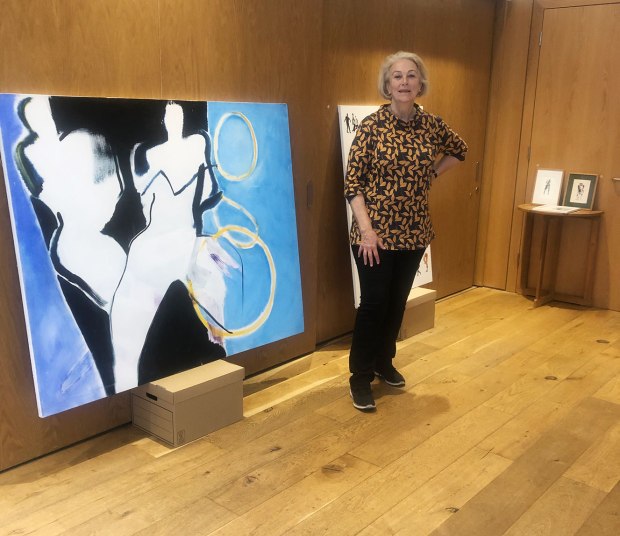
I love listening to a band or being in sync with the musicians as they play especially when they improvise. There is something magical that happens between musicians, or dancers, there is a moment when something new is created. It happens not just with modern dance, folk dance, or rehearsed dance performance on a stage. It can be anyone dancing anytime anywhere. This also happens with some live theatre performances like those of DV8 and Rose English’s play the ‘Double Wedding’ which I saw performed in Sloane Square in the 1990’s. This was an extraordinary performance with acrobats lowered from the ceiling, the story is that everyone has a double in another dimension but often closer than we realise. I made drawings in the dark in the theatre and then painted my own version of the ‘Double Wedding’.
A complete work of art is a collaboration between artist, artwork and viewer. A combination of what’s from you, and what the viewer is bringing of themselves as well. For example, my preparatory drawings for the painting called ‘Indian Dance’, where I was drawing in a railway station in Madras and looking back over drawings made during a dance performance from the previous day by women dancers carrying pots. These were rough sketches showing flashes of colour, the positions of hand movements, the shape of a pot, their swirling skirts and feet; they were very abstract drawings depicting the movement of the dance more than anything. But I met someone there who was curious to look at my drawings. He was from a little village outside the city with no knowledge of modern art. He recognised it was a drawing of a dance he knew from just these few marks and told me about the symbolic meanings from the shapes of the hands, feet and colours. This was a really special connection with someone free from jargonesque art language, with someone of a completely different worldview.
 Sheena Barnes